Berkeley hopes new budget strategy will curb rising costs
Faced with a persistent structural deficit, Berkeley is trying to figure out how to live within its means — while upholding its values.
Berkeley revenues are growing, but not fast enough to keep up with expenses, prompting a shift in how the city builds its budget.
"Our expenditures are the biggest problem. They're growing at a higher rate," Henry Oyekanmi, Berkeley's finance director, told officials Thursday. "So the question is… how do we live within those means? That's the issue we're having."
This year, city leadership decided to tackle Berkeley's "persistent" structural deficit head-on — rebuilding the budget from the ground up, requiring departments to cut positions and programs they can't afford.
On Thursday, staffers presented the new budget for the first time, to a council subcommittee, including their take on how to address projected nearly $30 million deficits in the next two fiscal years.
Tuesday night, the full Berkeley City Council will hear a similar presentation and the public will have a chance to weigh in.
This year's budget has been particularly fraught because the city says it can no longer rely on one-time solutions to address the deficit, requiring more disruption than the city has seen before.
In April, the city put forward its budget reduction plan, featuring slashed programs, 38 proposed layoffs and the elimination of 145 vacant positions.
About half of the actual layoffs — to police, fire and recreation services — won't happen if Berkeley voters pass a sales tax increase in November that would bring in about $9.5 million a year, the city said.
(Residents surveyed by the city have expressed likely majority support for the increase — although the level of support fell between February and April.)
The City Council still needs to vote before any changes are final.
Thursday's meeting took place before a City Council subcommittee focused on the budget.
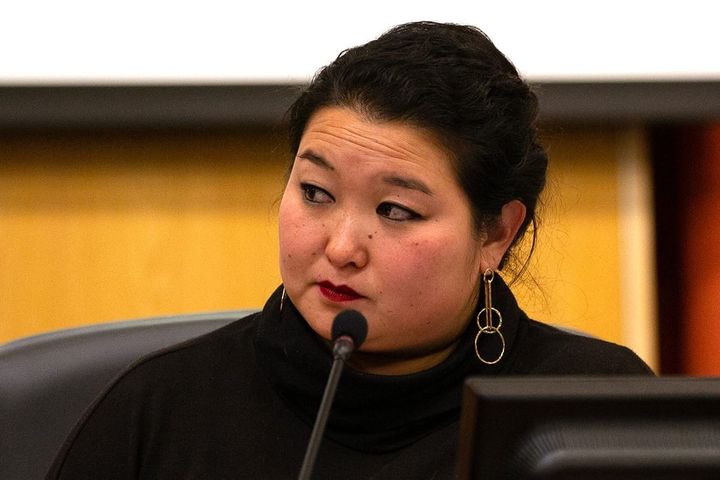
Mayor Adena Ishii heard the presentation along with council members Brent Blackaby and Igor Tregub (who was sitting in for Rashi Kesarwani).
The goal that day, City Manager Paul Buddenhagen explained to them, was to look at "why we got here" and "how we got here" in the lead-up to the June 23 budget vote.
Berkeley has a $900 million budget (and 215 separate funds), but discussions largely focus on the $300 million general fund, which has much of the discretionary funding.
Many of the city's fiscal challenges stem from rising costs — in personnel, pensions, health care and insurance, Maricar Dupaya, the city's budget manager, told officials.
As of last year, as one example, the city had $600 million in unfunded liabilities alone.
Berkeley's structural deficit is nothing new. But concern about it has grown, prompting a shift in strategy.
Dupaya said staff had gone back 10 years and determined that "the city costs grew faster than revenues," with 8% growth in spending and 6.5% in revenue, on average.
In recent years, the city used one-time solutions to keep up but "never addressed the underlying structural deficit," she said. "Although budgets were technically balanced, expenses continued to outpace revenues, and we faced structural deficits every single biennial budget."
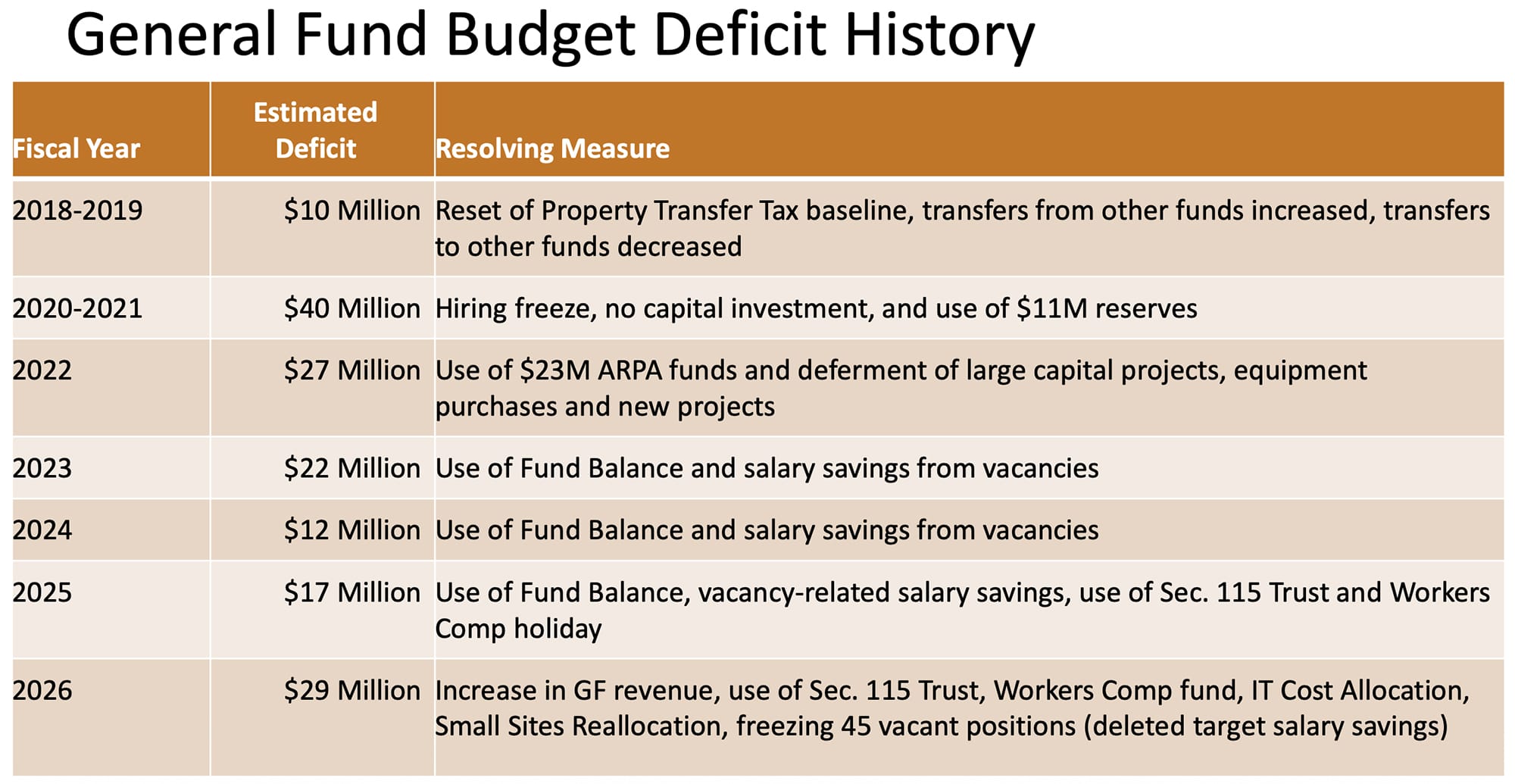
This year, the city decided on a new approach, Dupaya said, "not just balancing the budget, but balancing it strategically and structurally."
Staff looked at spending patterns and true costs, including for overtime, to rebuild Berkeley's baseline budget.
At that point, the numbers pointed to a projected general fund deficit of more than $32 million, prompting the city manager to launch "a citywide budget balancing exercise," asking each department to come up with cuts up to 12.5%.
After further refinements, the city set the projected deficits at $29.2 million in FY27, which runs from July 2026 through June 2027, and $29.5 million in the next year (FY28).
"Our goal has always been… a recurring, sustainable, structurally balanced budget," Dupaya said. "And to live within our values, and live within our means."
She continued: "While the impacts of the balancing plan and proposed budget are significant, the city conducted due diligence to mitigate effects whenever possible."
The bulk of the general fund — 70% — goes toward staffing, limiting the city's options to close the budget gap without layoffs.
"The choices got very difficult," she said.
Departments started by eliminating vacant positions and "only identified filled positions as a last resort."
 City of Berkeley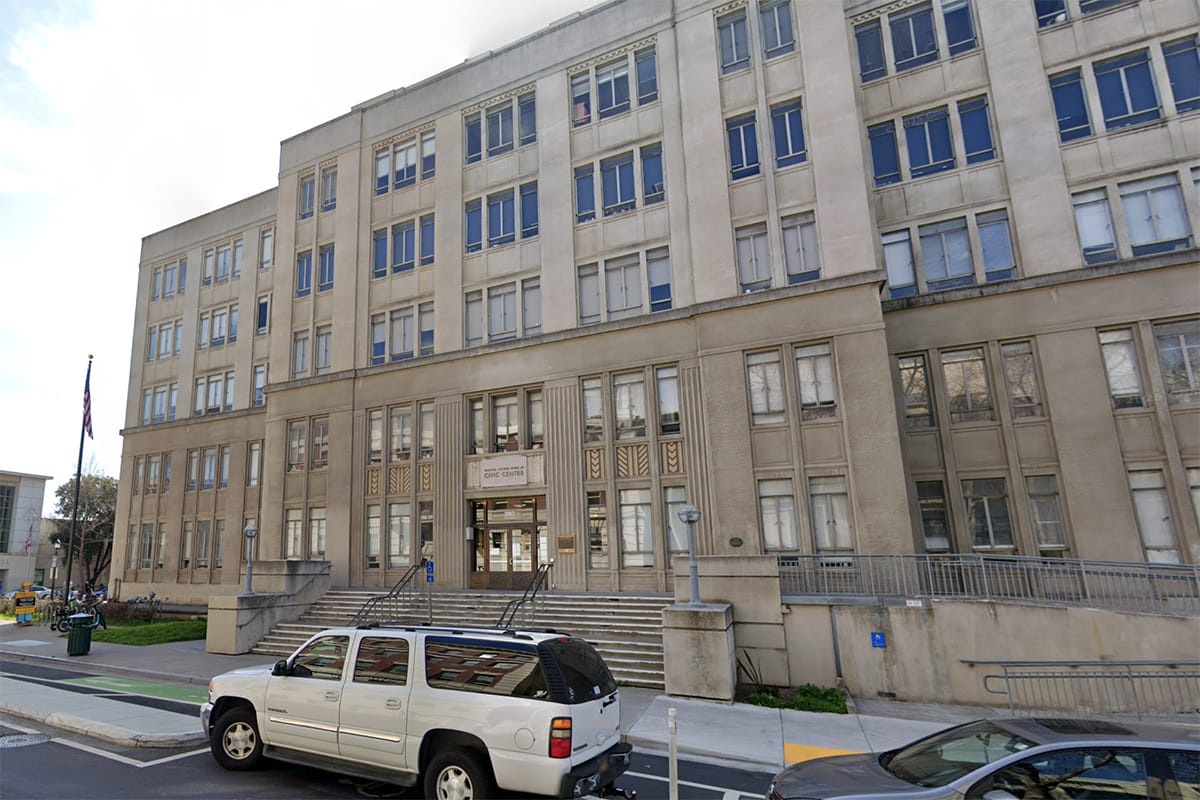
Currently, Berkeley has about 1,560 positions, excluding the library and Rent Board. Of those, about 212 are vacant, according to last week's presentation.
The budget balancing plan proposed 138 staff cuts (38 filled, 100 vacant).
That would drop to 20 filled and 85 vacant positions cuts with the new sales tax.
The 20 filled positions set to be cut include eight in Health, Housing, and Community Services (including two behavioral health clinicians, the mental health program supervisor, community health and community service specialists and a vector control technician).
There are also five cuts in the city manager's office (including two in communications); three in the fire department: a fire captain, program manager and analyst; two in the parks department (the waterfront manager and an engineer); and two in Public Works (a skilled laborer and an environmental compliance specialist).
In addition, there were 45 vacant positions that were not funded this year (2025-26) that would stay vacant, the city said.
According to the current timeline, the 20 employees slated to be laid off under the proposed budget would be notified July 2.
Mobile Crisis Team, vector control on the chopping block
Following the overview, Deputy City Manager David White went over the proposed staffing and program cuts designed to balance the budget.
Starting with Berkeley police, White said "the impacts to the department would be quite devastating" if not for one-time solutions and the expected success of the sales tax.
Staffing makes up 93% of BPD's general fund budget — and the department is already "operating at minimum staffing levels."
The balancing plan includes cuts to 25 police officers and 13 dispatchers, and reductions to special assignments, such as the Community Services Bureau, Bike Detail, Traffic Unit and detectives.
White said those units, along with 15 officer positions and six dispatchers, would be preserved through the sales tax, "which will enable us to continue to respond to 911 calls for service."
Eighteen vacant BPD positions would still be cut.
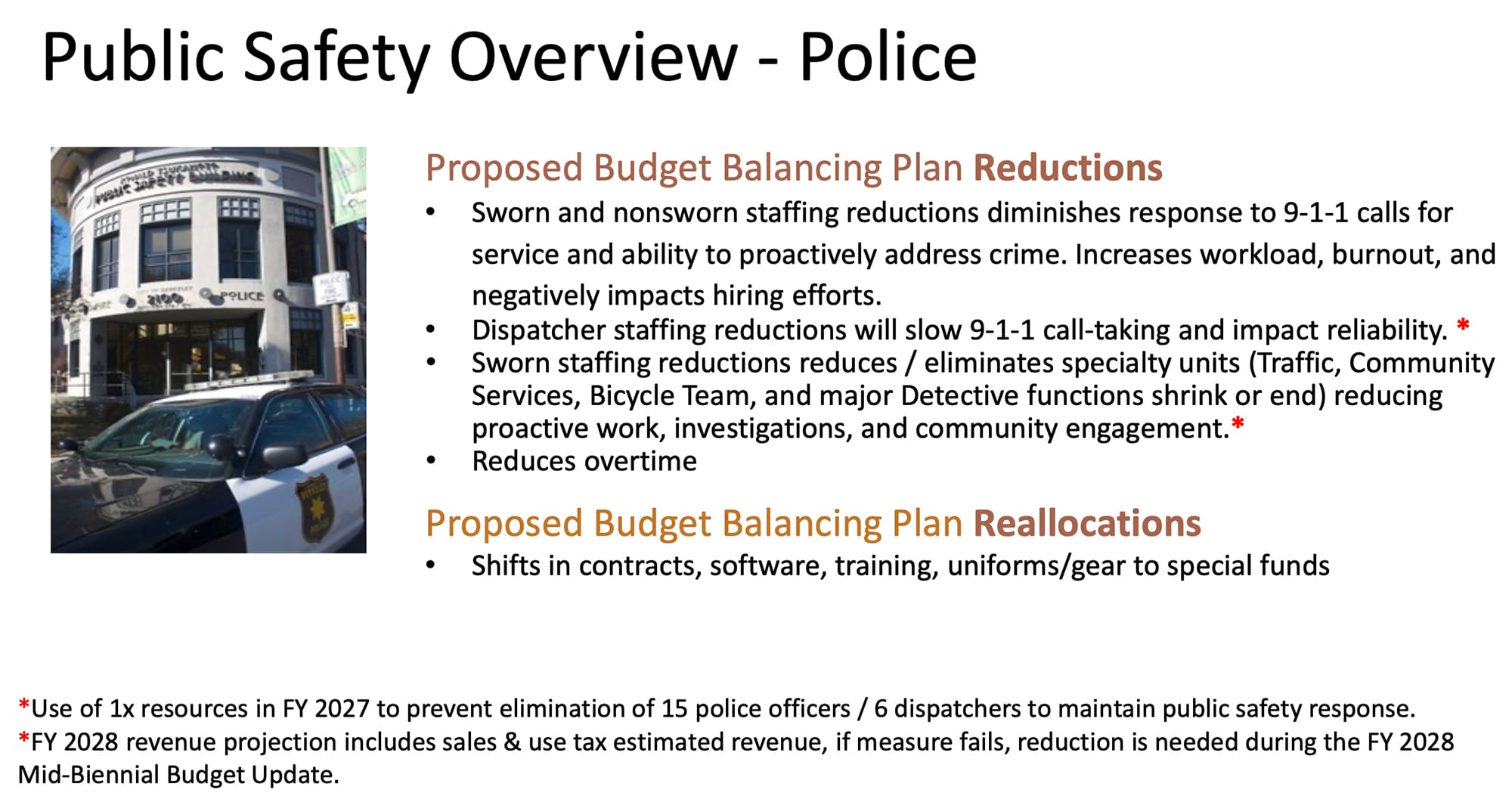
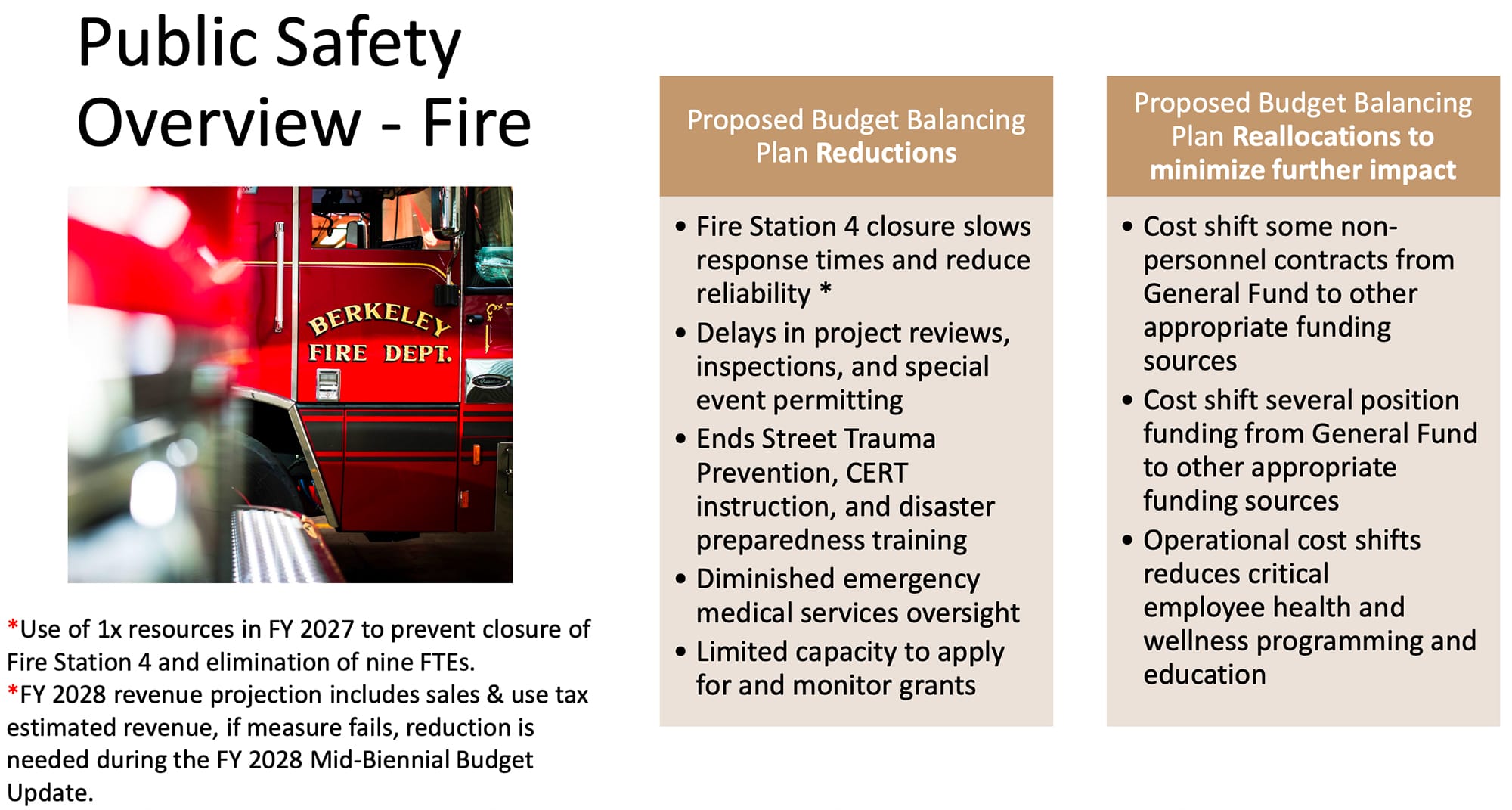
Planned budget cuts to police and fire services. City of Berkeley
As for the fire department, White described the proposed cuts as "significant and quite impactful to the community," but said many of them — including the closure of Station 4 and the termination of its nine firefighters — were on hold pending the sales tax vote.
Five BFD positions (three filled) are still slated to be cut in the new budget.
White said Health, Housing, and Community Services (HHCS) was also looking at significant impacts, exacerbated by the loss of major funding at the state and federal levels.
To that end, Berkeley plans to end its vector control program and Mobile Crisis Team and have the county pick up those services.
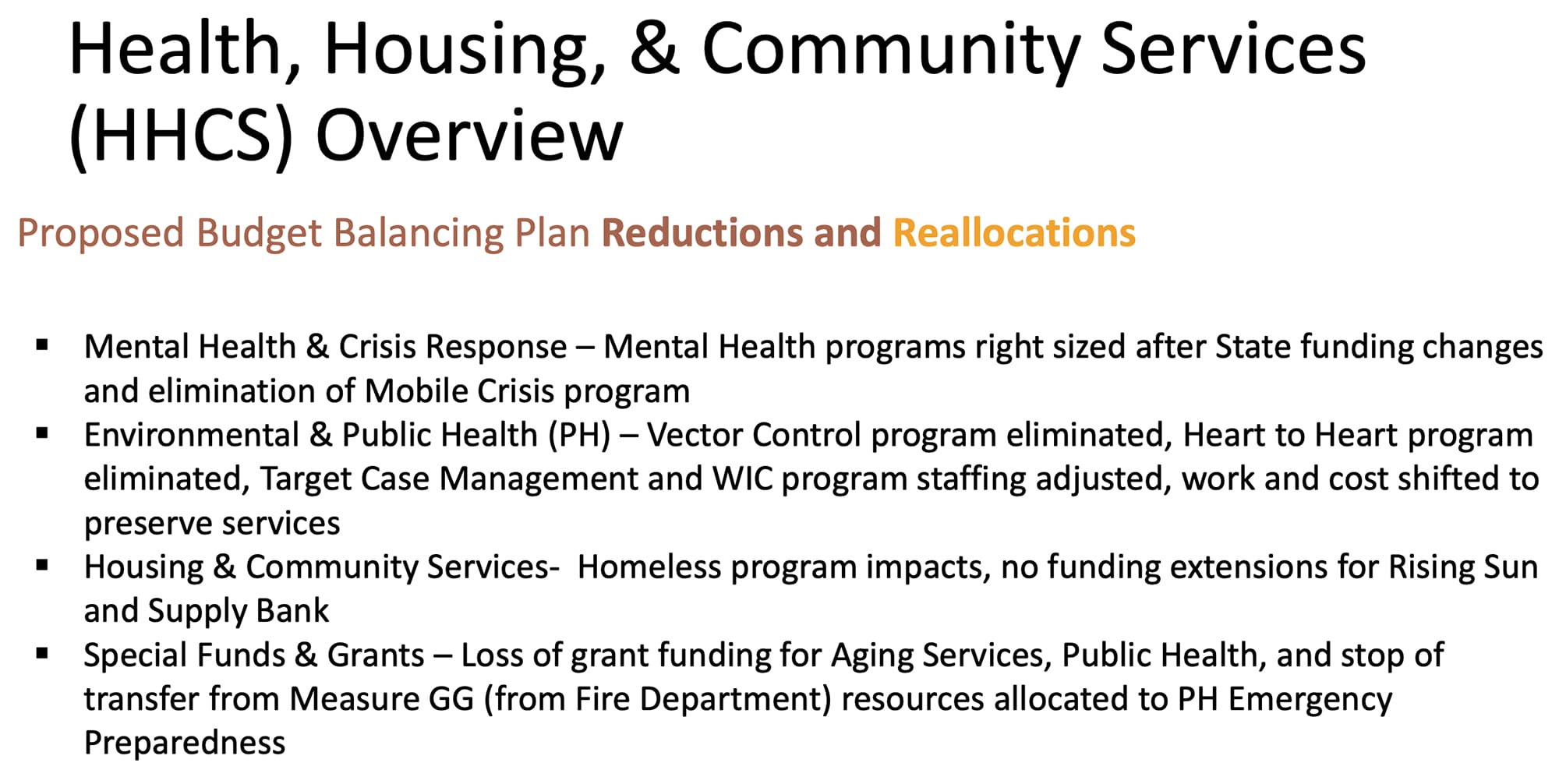
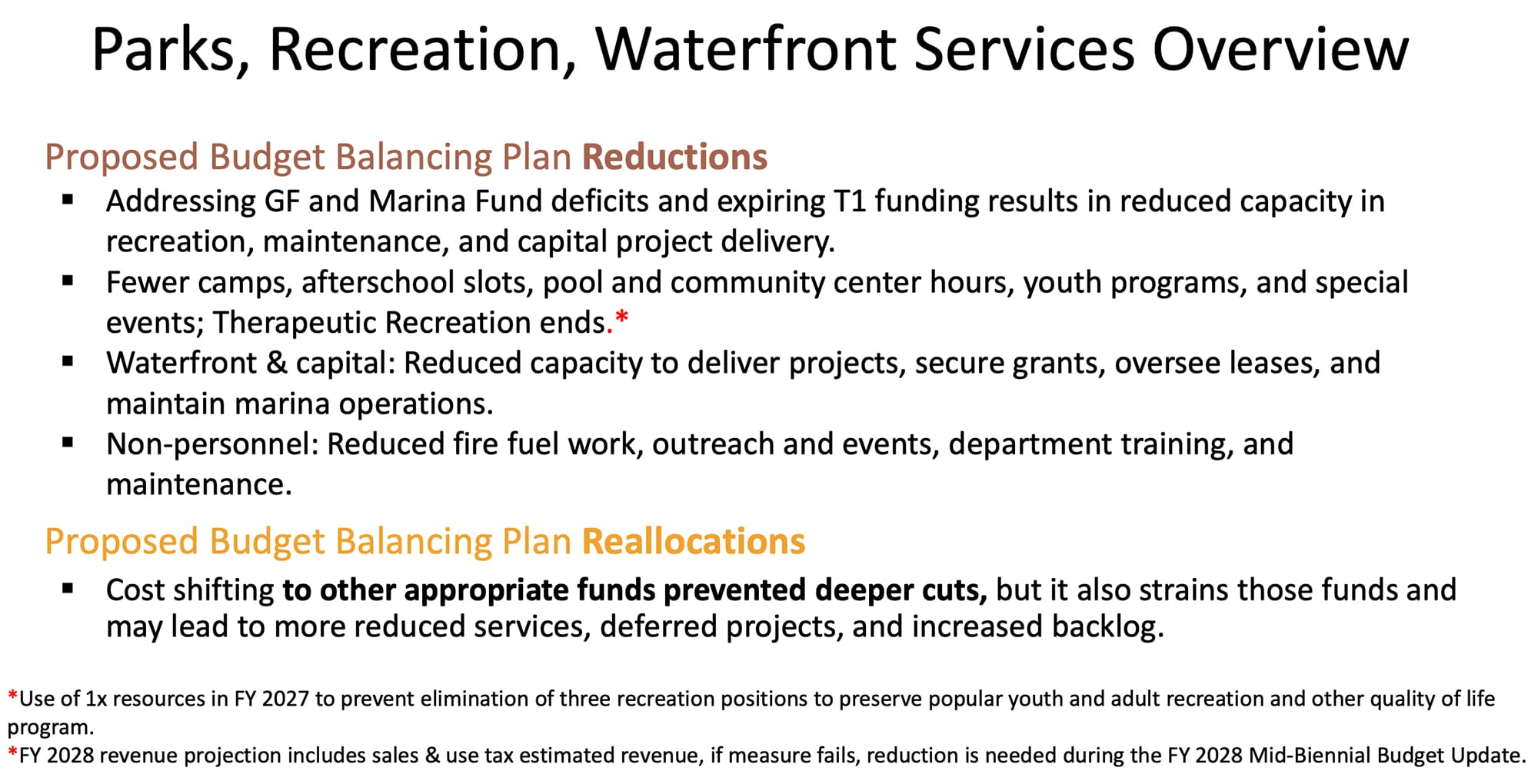
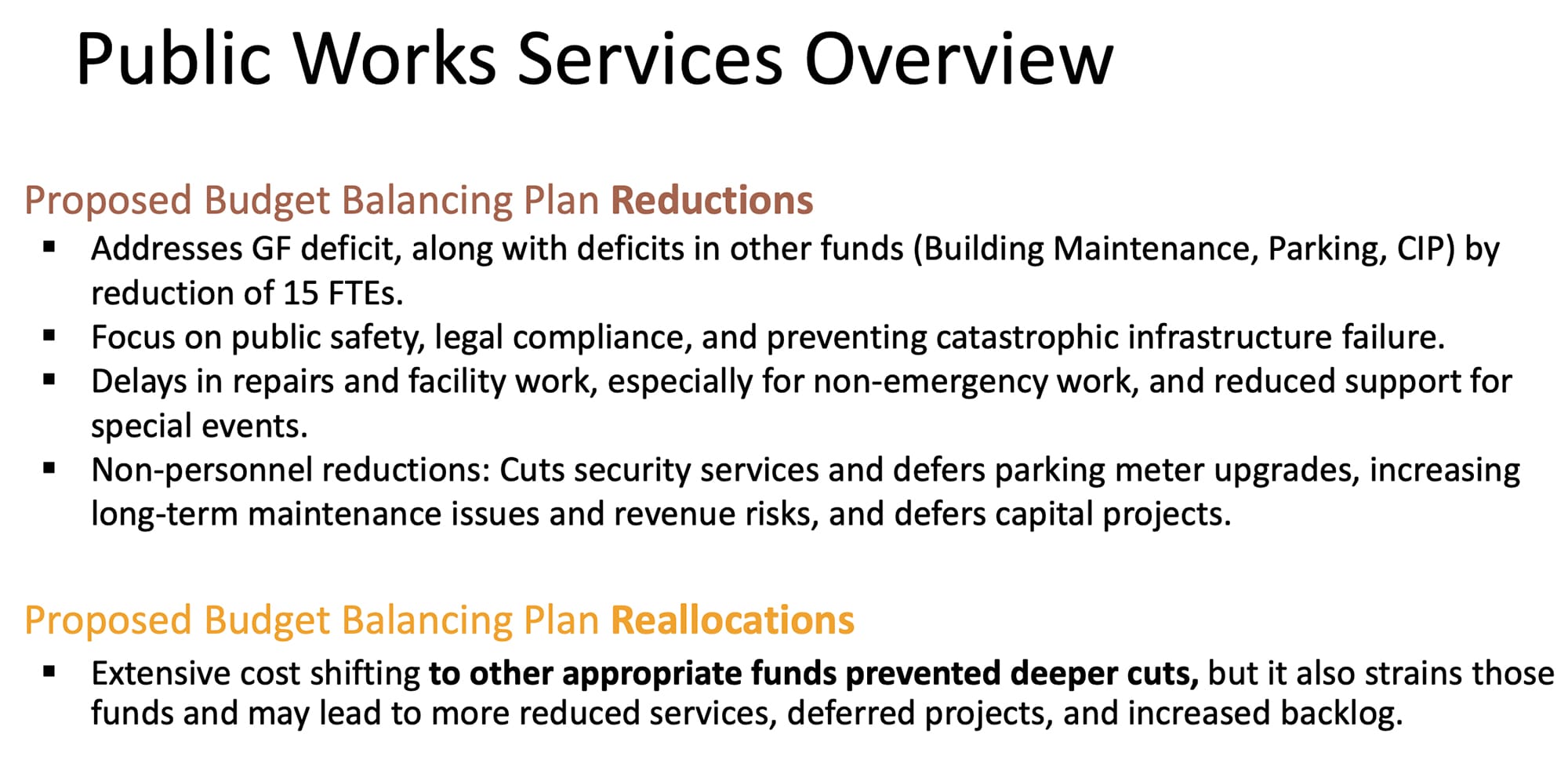
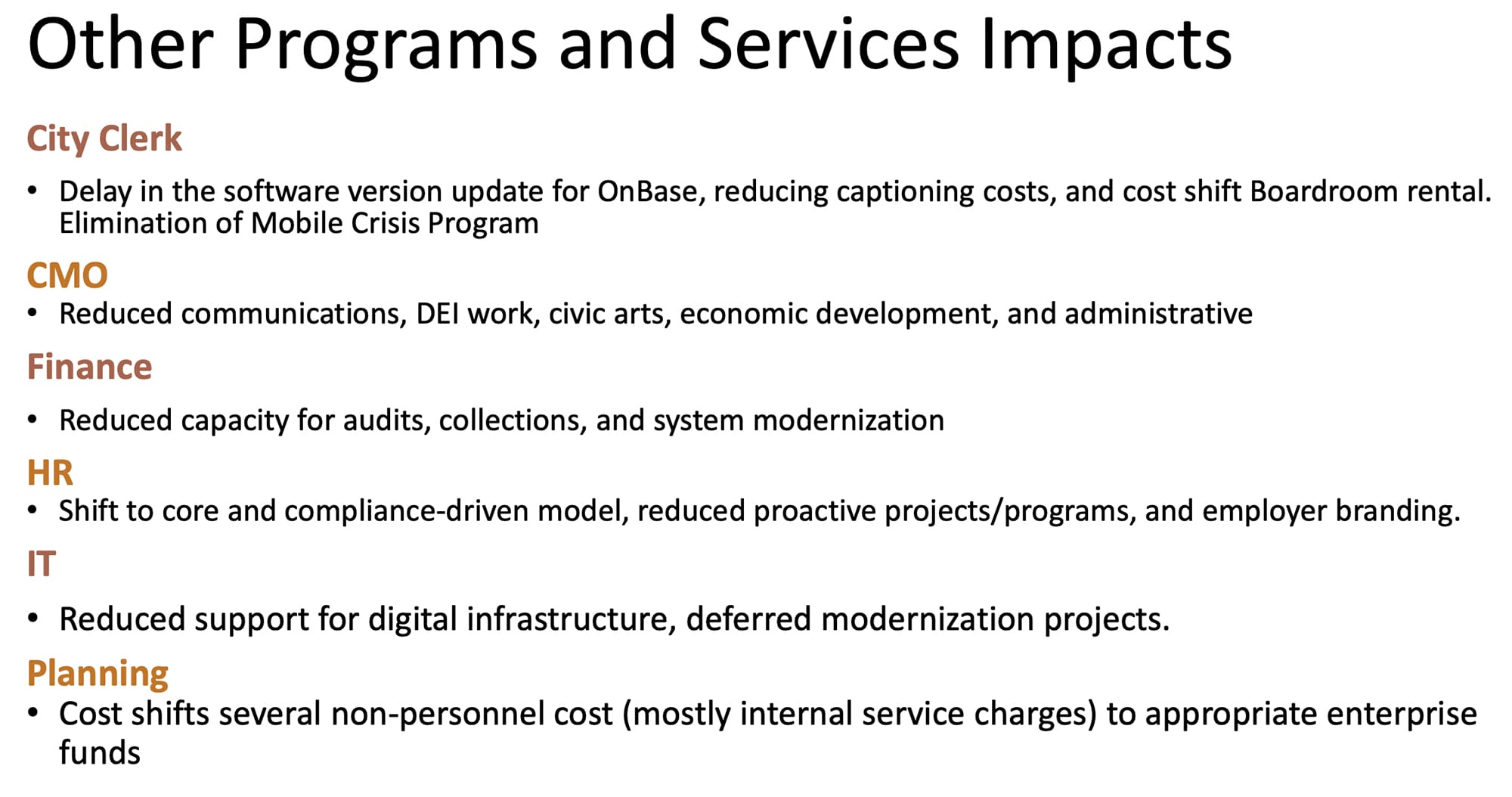
Planned budget cuts to HHCS, Parks, Public Works and other departments. City of Berkeley
Like HHCS, the city's Parks, Recreation & Waterfront department has "problems that are much bigger than the general fund," White said.
The department's parking funds have struggled for years, as has its Capital Improvements Fund — not to mention the city's astronomical infrastructure and maintenance needs.
As of last year, Berkeley had about $2.5 billion in deferred maintenance projects, such as street improvements and building needs.
The Marina Fund has had longstanding financial problems, which have only gotten worse since the DoubleTree hotel in the Berkeley Marina became "incapable of satisfying their rent obligations to the city because of the challenging tourism market," White said.
(The Real Deal, a real estate news website, broke the news about the DoubleTree's financial woes last year.)
White said the parks department would have to eliminate positions — prompting cuts to "camps, after-school programs, community center operating hours, as well as pool operating hours" — if not for the sales tax.
As it stands, three of the proposed staff cuts are on hold and three (two filled positions) are still on the table.
Finally, Public Works is looking at cuts to 15 positions (two filled), with no help from the sales tax.
White said the public would "see delays" in "graffiti removal, litter pickup, those types of services," as the department focuses on more critical services.
Last week, city officials asked for more clarity about the proposed cuts to staffing and programs, given that so much is on the table.
"I think it's just a little bit confusing about what's getting cut now, and what could get cut if the sales tax isn't passed," said Mayor Adena Ishii. "We've been talking about the biennial budget plan versus the balancing plan versus this budgeting plan for this year, so I feel like those things … could get easily conflated."
That's particularly true when it comes to actual layoffs, where concern is especially high, she said.
"It's important for folks to really make sure we understand what that means," Ishii said.
Spending on homelessness still a Berkeley priority
As part of this year's budget reduction exercise, the city manager's office asked department heads to consider jobs the county or others could be doing instead of Berkeley; whether positions generate revenue; and what positions have critical public safety or life safety consequences.
They asked staff to consider "what are the impacts to people that would happen as a result of this budget, specifically for people who are struggling the most, or need the most support," City Manager Paul Buddenhagen said.
In the end, the city tried to maintain its approach to homeless services to a large extent.
Staff did propose the elimination of the city's winter shelter program (since Old City Hall became uninhabitable) and reduced funding for the Stair Center on Second Street. (That program's capacity has also dropped.)
"We took great pains to minimize the impacts to our delivery of homeless services," White said. "We're continuing to allocate resources to a very comprehensive and broad-spectrum approach to addressing homelessness."
That includes investing in motel programs to get people off the street.
Last year, staff warned of an impending "fiscal cliff" that could result in the closure of two of those programs in the next two years.
White said the city had found money for one of them, but not the other: the Campus Motel, operated by Insight Housing, at 1619 University Ave., which has funding for just one more year.
He said the city is working with Insight to find other revenue so the Campus Motel might stay open.
Officials have said they hope Alameda County's Measure W, the half-cent sales tax increase approved by voters in 2020, could eventually help. (Following years of litigation, money began to be released by the county in March.)
 Emilie Raguso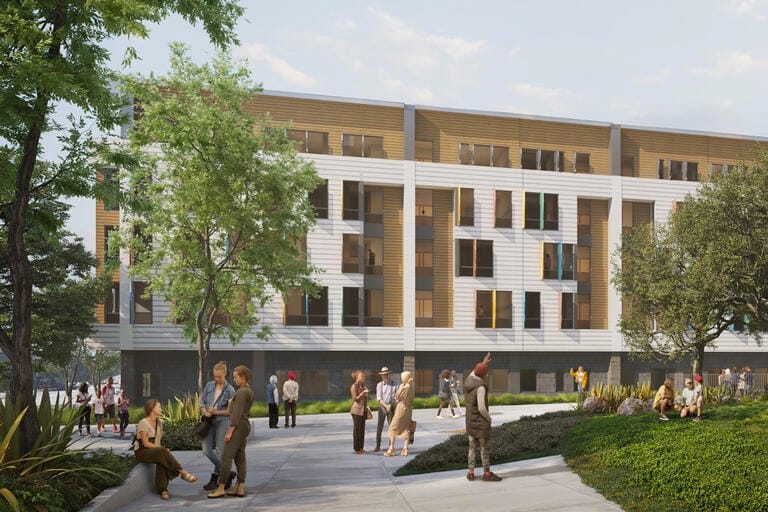
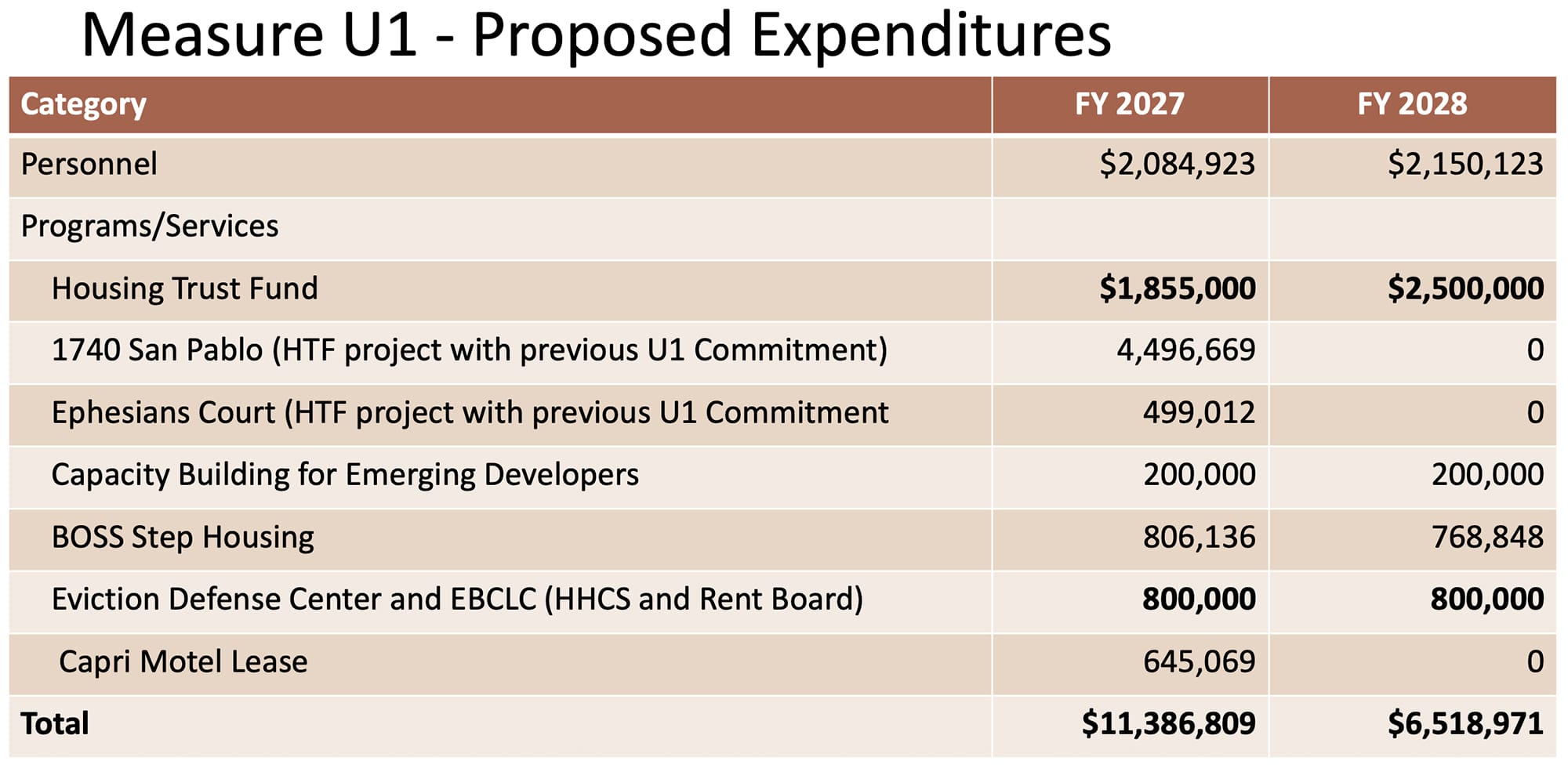
Aside from the Campus Motel, money for Berkeley's other two motel programs is slated to come from Measure U1, which also funds affordable housing, White said.
The city has more than 1,500 affordable units in the pipeline now thanks in part to Housing Trust Fund investments supported by U1.
But White cautioned officials that the money doesn't go as far as it once did.
Some developers have already come back to the city asking for help as construction costs and other expenses rise. White said that is likely to continue.
"Time is never on our side," he said. "There just are never enough resources to support affordable housing."
Berkeley sales tax increase: What's the plan?
On Tuesday, in a special 4 p.m. meeting, officials will discuss what ballot measures to put on the Nov. 3 ballot.
That includes a $300 million infrastructure bond as well as the half-cent sales and use tax.
As part of that process, a city consultant surveyed likely voters in February, finding 60% of them in support of the sales tax.
In April, in a second poll, the consultant found 52% in favor of the sales tax — although the number went up after residents heard arguments for and against it, according to agenda materials.
"Both City measures show somewhat less support than they did in February," the consultant wrote, although both are still showing enough support to pass.
The sales tax proposal would increase Berkeley’s rate from 10.25% to 10.75%, bringing in $9 million to $10 million each year "for general governmental purposes."
Fast-forward to November, if the sales tax fails, White told officials last week, staff will "go back to the drawing board" with all the departments and the City Council to determine what happens next.
"We should make sure that that's clear to folks," Ishii said. "We're saying in the budget, on one hand, that we're going to eliminate all these things if the sales tax hasn't passed. On the other hand, we're saying we're actually going to go back to the drawing board and try to prevent those layoffs from happening. So I think we just need to be clear."
White said it's a process issue: Staff has asked council to approve a budget assuming the sales tax will pass. That's already baked into the numbers.
If that doesn't happen, the landscape will have changed, requiring more public process.
"We'll have to come up with $9 million of additional cuts, and you have our proposal, which is the fire station, the police officers, Public Works and Parks & Rec staff," said Buddenhagen, the city manager. "But obviously it's a council decision, so we'd have to have a bigger discussion about it."
What's next for the FY27/28 Berkeley budget?
Several more public meetings on Berkeley's proposed budget are planned before the vote. Find full agendas and other documents as they are posted on the City Council page.
- May 19: First full City Council public hearing on the proposed budget
- May 28: Council budget policy committee hears the "mayor's budget"
- June 9: Full council meeting on the Capital Improvement Plan (see the prior plan, for 2025-29)
- June 16: Potential City Council discussion on the budget
- June 23: Planned City Council vote on the FY27/28 budget and Capital Improvement Plan
- City presentation on proposed budget (May 14, policy committee)
- Budget staff report (May 19, City Council)
- Budget balancing plan (April 14)
- Policy Committee: Budget & Finance
- Berkeley City Budget overview
Read more about the city budget in past Berkeley Scanner coverage.
Editor's note: TBS reviewed this meeting remotely to report this story.